NBCE SPEC Exam 2026: How to Prepare for the October & December Chiropractic SPEC Exam
Sep 02, 2026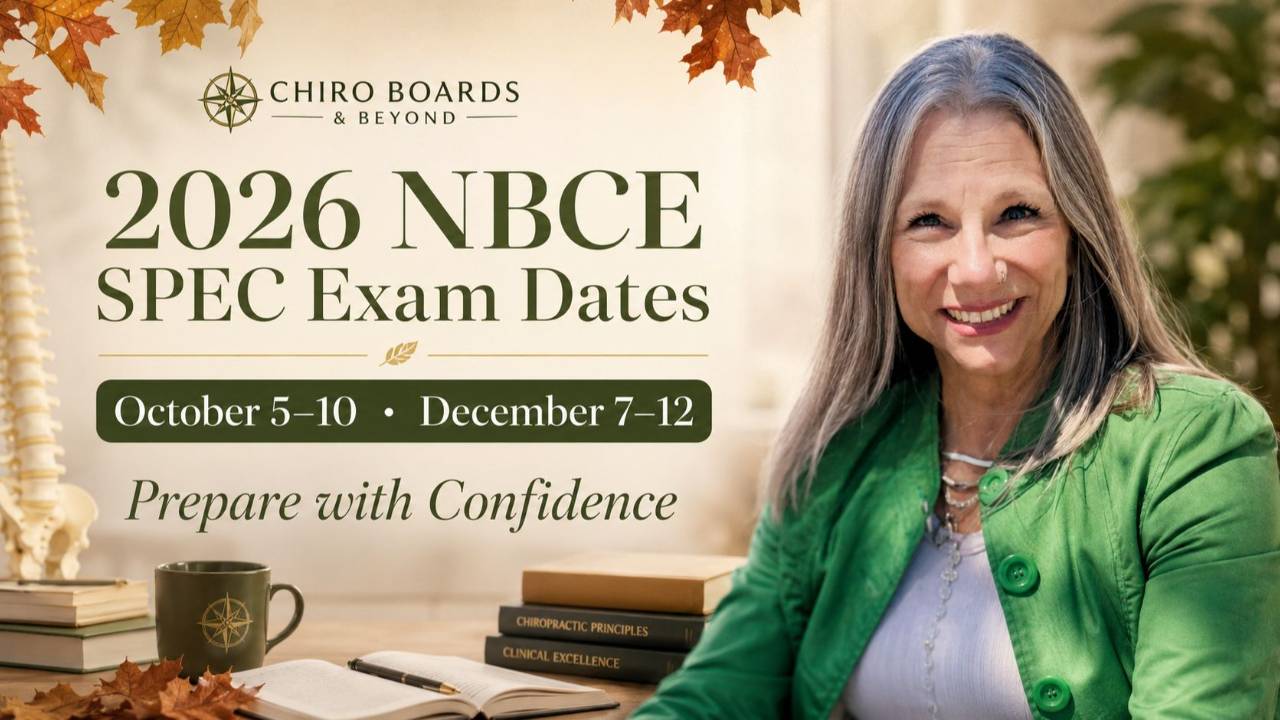
Updated September 2026
Preparing for the NBCE SPEC Exam can feel overwhelming, particularly if it has been several years since you last took a National Board examination.
The Special Purposes Examination for Chiropractic (SPEC) is designed to assess clinical competency, which means preparing for it requires more than simply memorizing isolated facts.
You need to be able to take the foundational information you learned in chiropractic school and apply it to clinical situations involving diagnosis, diagnostic imaging, examination findings, chiropractic procedures, treatment decisions, contraindications, physiotherapy modalities, and patient management.
For a practicing chiropractor, there is an advantage: you already think clinically every day.
The key is learning how to translate that clinical knowledge back into the way National Boards ask the questions.
What Is the NBCE SPEC Exam?
The Special Purposes Examination for Chiropractic (SPEC) is a post-licensure examination used to assess clinical competency.
Unlike Parts I–IV of the National Boards, which chiropractors generally encounter during chiropractic school and the initial licensure process, SPEC may be requested by a state licensing board under various circumstances.
According to the National Board of Chiropractic Examiners, SPEC can be used by licensing boards when reassessing a doctor's clinical competency.
This is important because many doctors preparing for SPEC haven't taken a National Board examination in years.
You may have spent those years treating patients, building a practice, completing continuing education, raising a family, managing employees, or developing expertise in a particular area of chiropractic practice.
Then suddenly, you are studying for National Boards again.
That can feel like a lot.
But you are not starting over.
The goal is to reconnect what you learned in school with the clinical experience you have developed since then.
Who Needs to Take the Chiropractic SPEC Exam?
SPEC is not simply an examination for doctors who have been out of practice.
Depending on the requirements of an individual state licensing board, SPEC may be used in circumstances involving:
- Reassessment of clinical competency
- A lapse in licensure
- Licensure suspension or revocation
- Disciplinary circumstances
- Reciprocity or endorsement when seeking licensure in another state
- Other situations in which a licensing board requires demonstration of current clinical competency
Your individual licensing board determines whether SPEC is required for your particular situation.
If you have been instructed to take SPEC, always verify your specific licensing requirements with the appropriate board.
2026 NBCE SPEC Exam Dates: October & December
There are two remaining SPEC testing periods in 2026:
October 2026 SPEC Exam
Testing appointments: October 5–10, 2026
Application/changes deadline: September 30, 2026
December 2026 SPEC Exam
Testing appointments: December 7–12, 2026
Application/changes deadline: December 2, 2026
If you are preparing for the October examination, your focused review should already be underway.
If you are preparing for December, you have additional time, but that does not mean you should wait until November to begin.
Most doctors taking SPEC are balancing studying with patients, work, family, and other responsibilities. A structured study plan gives you time to actually understand and integrate the information instead of trying to cram everything during the final week.
What Is Tested on the SPEC Exam?
SPEC preparation requires you to bring together multiple areas of clinical chiropractic knowledge.
Your review should include concepts involving:
- General diagnosis and systemic conditions
- Neuromusculoskeletal diagnosis
- Orthopedic and neurological examination
- Diagnostic imaging and X-ray
- Chiropractic procedures and technique
- Clinical case management
- Treatment indications and contraindications
- Physiotherapy modalities within clinical management
- Appropriate diagnostic testing
- Differential diagnosis
- Recognition of conditions requiring referral
- Selecting the appropriate next step in patient care
The important distinction is that you should not study these subjects as completely isolated categories.
Instead, continually ask yourself:
“What would I do if this patient walked into my office?”
That changes the way you process the information.
Rather than simply identifying a diagnosis, you begin thinking about what should happen next.
What additional examination is appropriate?
Does this patient need imaging?
Is chiropractic treatment appropriate?
What management strategy makes sense?
Is there a treatment or modality that would be contraindicated?
Does this patient need referral?
That is clinical reasoning—and it should be at the center of your SPEC preparation.
Is Physiotherapy on the NBCE SPEC Exam?
This is a question I have received directly from doctors preparing for SPEC:
“Do I need to study physiotherapy modalities for the SPEC exam?”
You should understand physiotherapy modalities and, most importantly, how they relate to the clinical management of specific conditions.
However, I would not approach SPEC as though you were preparing for the standalone NBCE Physiotherapy examination.
The NBCE offers Physiotherapy as a separate examination covering passive and active adjunctive procedures.
For example, rather than simply memorizing:
“What are the contraindications for a heating modality?”
put that information into the context of a patient.
Consider a patient with multiple sclerosis.
Heat can exacerbate neurologic symptoms in patients with MS. Therefore, your understanding of heating modalities is relevant to the condition you are managing.
Now the information isn't an isolated fact.
It has a patient attached.
That is also how physiotherapy and modality information is incorporated into the Chiro Boards & Beyond SPEC Review.
Rather than separating each modality into an isolated physiotherapy lecture, I integrate relevant modalities, indications, contraindications, and management considerations into the conditions in which you need to understand them clinically.
How to Study for the NBCE SPEC Exam
One of the biggest mistakes I see doctors make when returning to National Boards is trying to memorize everything.
You don't need to approach SPEC as a collection of thousands of disconnected facts.
Instead, build clinical pictures.
When reviewing a condition, ask yourself:
Who gets it?
Consider age, sex, occupation, risk factors, and relevant history.
How does it present?
What would this patient actually tell you?
What would I expect to find on examination?
Think orthopedic testing, neurological findings, and physical examination findings.
What diagnostic testing might be appropriate?
What might I see on imaging?
What else could look like this?
Build your differential diagnosis.
Can I treat this patient?
What management is appropriate?
What treatment or modality could be contraindicated?
When should I refer?
When you organize your studying this way, you aren't memorizing a page.
You are building a patient.
For practicing doctors, that can make the material significantly easier to retrieve.
How to Study Diagnostic Imaging for the SPEC Exam
Diagnostic imaging is one of the areas that creates significant anxiety for doctors returning to National Boards.
If you haven't routinely interpreted films in practice, you may feel rusty.
Don't begin by staring at an image and trying to immediately name the diagnosis.
Use a system.
Ask:
Where is the abnormality?
What structure is involved?
What is happening to the bone?
Is the process destructive, productive, or both?
Is the joint space affected?
Is there a recognizable distribution or pattern?
Does the patient's age fit?
Does the clinical presentation fit the imaging findings?
Then build your differential diagnosis.
A systematic approach gives you something to fall back on when you encounter an image that you don't immediately recognize.
Why Practice Questions Matter for SPEC Exam Preparation
Watching lectures and reviewing notes builds knowledge.
Practice questions teach you to retrieve and apply that knowledge under pressure.
When you miss a question, don't simply memorize the correct answer.
Ask:
Why is the correct answer correct?
Then go one step further:
Why are the other answers incorrect?
Understanding the incorrect answer choices can be just as valuable as understanding the correct one.
This is especially important with clinical vignettes because several choices may initially appear reasonable.
NBCE also provides official sample testing resources that can help doctors become familiar with National Board-style testing.
Common SPEC Exam Study Mistakes
Trying to Memorize Everything
You do not have to know every fact perfectly to answer questions correctly.
You need enough knowledge to recognize what fits—and what doesn't.
When you don't immediately know the answer, start with:
“What do I know this is NOT?”
Eliminate the choices you can prove are incorrect.
Then compare what remains with the clinical information in the question.
Overthinking the Question
One of my most repeated pieces of board advice is:
Answer the question they asked.
Not the question you are afraid they might be asking.
Not the more complicated version you created in your head.
Read what is actually in front of you.
Changing Answers Because You're Anxious
If an answer immediately comes to mind, don't automatically dismiss it because you aren't 100% certain.
First, try to justify it.
Does it fit the presentation?
Can you eliminate the other choices?
Is there a clinical fact that proves your initial answer cannot be correct?
If not, be careful about changing an answer simply because anxiety has convinced you there must be a trick.
How Long Should You Study for the SPEC Exam?
There is no single study schedule that works for every doctor.
A doctor who has recently completed chiropractic school may have very different needs from someone who has been practicing for 10, 20, or 30 years.
Your schedule should account for:
- How long you have been away from board-style testing
- How comfortable you are with diagnostic imaging
- How much of your current practice overlaps with the material
- Your test-taking confidence
- Your work and patient schedule
- Family responsibilities
- How much time you can realistically study each week
The Chiro Boards & Beyond SPEC Review includes more than 20 hours of recorded instruction, so don't plan to binge-watch the entire program immediately before your examination.
Give yourself time to:
Learn → Review → Practice → Identify weaknesses → Review again
Spacing your studying allows you to determine what actually needs additional attention.
Chiro Boards & Beyond SPEC Review
I created the Chiro Boards & Beyond SPEC Review specifically for doctors who need to organize the enormous amount of clinical information that can potentially appear on SPEC.
The program contains 20+ hours of recorded instruction that you can complete on your own schedule.
The review brings together concepts involving:
- General Diagnosis
- Neuromusculoskeletal Diagnosis
- Diagnostic Imaging/X-ray
- Clinical case management
- Chiropractic procedures and technique
- Condition-specific treatment considerations
- Relevant modalities, indications and contraindications
- Clinical decision-making
But the biggest difference is how I teach it.
I don't want you memorizing random facts solely because they might appear on National Boards.
I want you to understand:
Why does this matter clinically?
What would this look like in a patient?
What would I do next?
That is the “Beyond” in Chiro Boards & Beyond.
The goal is to prepare you for your examination while connecting that educational knowledge back to clinical practice.
Doctors Have Scored 800 and 795 Using the Recorded SPEC Review
Does this approach translate to the actual SPEC examination?
We have seen some incredible results.
Doctors using the recorded Chiro Boards & Beyond SPEC Review have earned:
800 — a perfect SPEC score
and
795
These doctors used the recorded program as the foundation of their SPEC preparation.
Their results reinforce something I have seen throughout more than 20 years of teaching National Board material:
Understanding the material is more powerful than simply memorizing it.
One-on-One SPEC Exam Tutoring
Some doctors are comfortable working independently through the recorded SPEC Review.
Others want more practice.
That's why I also offer one-on-one SPEC tutoring.
During tutoring, we can work through board-style practice questions and clinical vignettes together in real time.
I don't simply want to know which answer you selected.
I want to know:
How did you get there?
That allows us to identify whether you are:
- Missing the underlying clinical information
- Misreading the vignette
- Having difficulty identifying what the question is asking
- Struggling to eliminate distractors
- Second-guessing correct answers
- Having difficulty translating your clinical knowledge into board-style questions
We can also focus specifically on areas where you need additional support, including diagnosis, NMS, diagnostic imaging, clinical management, modalities, or test-taking strategy.
Frequently Asked Questions About the NBCE SPEC Exam
What is the NBCE SPEC exam?
The Special Purposes Examination for Chiropractic (SPEC) is a post-licensure examination used to assess clinical competency. State licensing boards may require SPEC under various circumstances, including competency reassessment, licensure issues, or reciprocity and endorsement requirements.
Who has to take the SPEC exam?
SPEC requirements depend on the individual state licensing board. A board may require the examination when assessing clinical competency, following certain licensure circumstances, or as part of obtaining licensure through reciprocity or endorsement. Always verify your individual requirements with the appropriate licensing board.
When is the SPEC exam offered in 2026?
The remaining 2026 testing periods are October 5–10, 2026, with an application/changes deadline of September 30, and December 7–12, 2026, with an application/changes deadline of December 2.
What should I study for the chiropractic SPEC exam?
SPEC preparation should include clinical diagnosis, neuromusculoskeletal conditions, orthopedic and neurological examination, diagnostic imaging, chiropractic procedures and technique, clinical management, differential diagnosis, treatment indications and contraindications, and appropriate clinical decision-making.
Is physiotherapy on the SPEC exam?
Doctors preparing for SPEC should understand physiotherapy modalities as they relate to clinical patient management, including appropriate indications and contraindications. SPEC preparation should focus on how those modalities apply to the condition being presented rather than treating modality information as completely isolated facts.
Is diagnostic imaging on the SPEC exam?
Diagnostic imaging is an important component of clinical chiropractic competency. Doctors should be comfortable evaluating imaging systematically, recognizing common findings, and integrating them with the patient's history, examination, and differential diagnosis.
Are there SPEC practice questions?
Practice questions are an important part of SPEC preparation because they require you to retrieve and apply information rather than simply recognize it in your notes. NBCE provides official sample-testing resources, and additional board-style clinical questions can be worked through during Chiro Boards & Beyond tutoring.
Can I get one-on-one tutoring for the SPEC exam?
Yes. Chiro Boards & Beyond offers one-on-one SPEC tutoring where we can work through clinical cases, practice questions, and your individual areas of weakness together in real time.
Start Preparing for Your October or December 2026 SPEC Exam
If you are taking the October 5–10 or December 7–12, 2026 NBCE SPEC Exam, give yourself enough time to prepare strategically.
You have already done the hard work of becoming a chiropractor.
You are not starting from zero.
Your job now is to take what you already know, strengthen the areas you haven't used recently, organize the information for National Boards, and practice applying it to clinical questions.
The Chiro Boards & Beyond SPEC Review gives you more than 20 hours of recorded instruction designed to help you do exactly that.
Prefer to work through questions together?
Chiro Boards & Beyond
Because Your Nervous System Matters as Much as Your Score.
About Dr. Jo Kaleta
Dr. I. Jo Kaleta, DC, CCSP has more than 20 years of experience teaching National Board chiropractic examination preparation and has instructed thousands of chiropractic students and doctors.
She created Chiro Boards & Beyond to move board preparation beyond memorizing disconnected facts. Her teaching focuses on helping examinees understand the material, apply it clinically, develop stronger test-taking strategies, and carry that knowledge beyond National Boards and into clinical practice.
Doctors using the Chiro Boards & Beyond SPEC Review have achieved scores as high as 795 and even a perfect 800!