New NBCE Part IV Format in Greeley, Colorado: How to Prepare for Patient Encounters, SOAP Notes, and Clinical Reasoning
May 24, 2026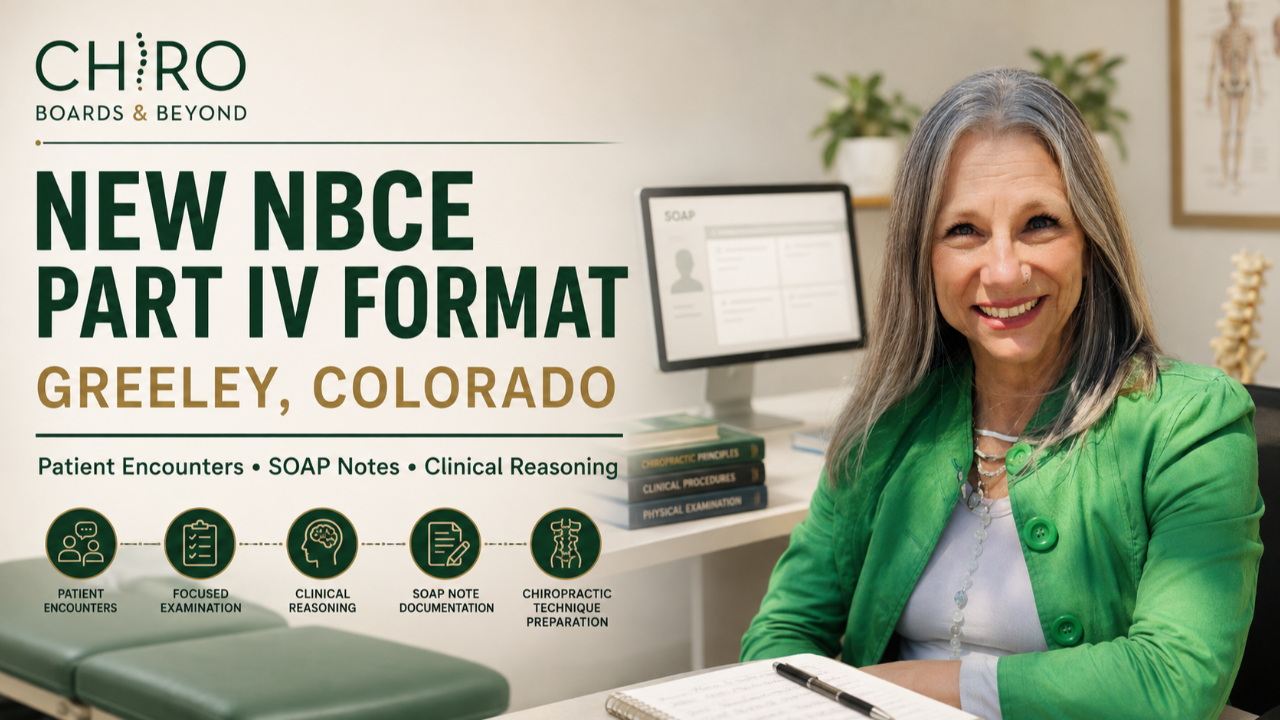
New NBCE Part IV Format in Greeley, Colorado: How Chiro Boards & Beyond Prepares Chiropractic Students for Patient Encounters, SOAP Notes, and Clinical Reasoning
The new NBCE Part IV format at the NBCE Assessment Center in Greeley, Colorado, is changing how chiropractic students prepare for the boards. Instead of only moving through short, isolated stations, students now need to demonstrate clinical reasoning through patient encounters, focused examinations, communication, case management, SOAP note documentation, and technique setup.
The first live exam at the Greeley, Colorado NBCE Assessment Center began April 10, 2026, and NBCE states that the goal of the updated format is to create an exam that better mimics real-world patient encounters while maintaining fairness, reliability, and validity.
For chiropractic students, this means one thing very clearly:
The way you study for Part IV must change.
Memorizing orthopedic tests, listings, and isolated facts is no longer enough. The new format requires students to organize information in the way they will use it clinically with a patient: through history-taking, examination, clinical interpretation, management decisions, communication, documentation, and technique.
That is exactly why Chiro Boards & Beyond is organized around clinical reasoning, pattern recognition, and real-world application.
What Changed with the New NBCE Part IV Format?
For exams at the NBCE Assessment Center, the updated Part IV format includes seven Patient Encounter Stations and one Technique Station, for a total of eight stations. At the Patient Encounter stations, examinees perform a focused case history and examination, provide a brief report of findings, and then complete a SOAP note at a computer station.
NBCE lists the grading domains for the Patient Encounter stations as:
Patient Evaluation
Patient Examination
Clinical Decision Making & Case Management
Interpersonal & Communication Skills
Documentation
The Technique Station focuses on the setup of ten chiropractic adjustments, including patient position, doctor position, segmental contact point, doctor’s contact point, stabilization, and line of correction. Communication and professionalism are also graded.
This matters because the new Part IV exam is not simply asking students, “Do you know this test?”
It is asking:
Can you think through a patient encounter as a doctor would?
Is the New NBCE Part IV Exam in Denver or Greeley?
Many students refer to the new testing location as “Denver” because they may travel through the Denver area when flying into Colorado. However, the official NBCE Assessment Center is in Greeley, Colorado.
NBCE’s planning information also notes that students may need to arrange travel to Colorado and that the shuttle route from Denver International Airport to Greeley is approximately 60 miles, with a minimum travel time of 1 hour.
So, for search purposes and student clarity, it is helpful to say:
The new NBCE Part IV exam is at the NBCE Assessment Center in Greeley, Colorado, near the Denver travel corridor.
That wording is both accurate and student-friendly.
Why the New NBCE Part IV Format Requires a Different Study Strategy
The older Part IV format rewarded repetition, memorization, speed, and station-specific performance. Those skills still matter, but the new format requires a more integrated type of preparation.
The updated exam includes cases that may be treatable in a chiropractic office, cases that may require additional diagnostic testing or co-management, and cases that require urgent referral or are outside the scope of chiropractic care.
That means students must be able to determine:
What is most likely to happen clinically?
What questions need to be asked?
What examination procedures are appropriate?
What findings support or weaken a working diagnosis?
Whether the case is chiropractic-manageable, co-managed, or urgent.
How to explain findings to the patient.
How to document the encounter clearly in a SOAP note.
This is why Chiro Boards & Beyond does not teach Part IV as a random collection of facts.
It teaches Part IV as a clinical reasoning process.
How Chiro Boards & Beyond Organizes Part IV Board Review for the New Format
Chiro Boards & Beyond is designed around one central learning principle:
Students remember more when information is organized the way they will need to retrieve it.
On exam day, students are not asked to recite an orthopedic textbook. They are placed in a patient encounter and expected to think.
That is why the program organizes information around the clinical flow of the new exam:
History → Examination → Interpretation → Case Management → Communication → Documentation → Technique
This structure helps students reduce cognitive overload because they are not trying to pull disconnected facts from memory. Instead, they are moving through a repeatable clinical framework.
When students know the structure, they can think more clearly under pressure.
Patient Encounter Stations: Learning to Think Like a Doctor
The Patient Encounter stations are one of the most important changes in the new NBCE Part IV format. Students must take a focused history, perform a focused examination, provide a brief report of findings, and then complete a SOAP note.
That means preparation must go beyond memorizing tests.
Students need to understand how to move from symptoms to clinical reasoning.
For example, if a patient presents with shoulder pain, the student needs to consider more than “which shoulder orthopedic tests do I know?”
They need to think through possible categories:
Rotator cuff involvement
Impingement
Instability
Cervical referral
Neurological involvement
Inflammatory disease
Visceral referral
Red flags
This is the kind of thinking Chiro Boards & Beyond emphasizes.
The goal is not simply to know more facts.
The goal is to know what matters, when it matters, and how to use it clinically.
Focused History: Asking Questions That Actually Lead Somewhere
In the new Part IV format, history-taking is not just a checklist. It is the beginning of the clinical decision-making process.
Students need to know how to ask questions that help narrow the case.
That includes questions about:
Mechanism of injury
Symptom location
Onset
Duration
Aggravating factors
Relieving factors
Neurological symptoms
Functional limitations
Red flags
Relevant previous history
A focused history should help the student decide what examination procedures are appropriate.
Chiro Boards & Beyond teaches students to use the case history as a clinical filter, not a memorized script.
Focused Examination: Choosing the Right Tests for the Case
The new NBCE Part IV test plan specifically includes the “accuracy and appropriateness of examination procedures” within the Patient Examination grading domain.
The word appropriateness is important.
It means students are not only being evaluated on whether they can perform a test. They are also being evaluated on whether the test makes sense for the patient’s presentation.
Chiro Boards & Beyond organizes examination content into clinical clusters so students can retrieve information more easily:
Cervical spine patterns
Lumbar spine patterns
Upper extremity patterns
Lower extremity patterns
Neurological screening
Orthopedic confirmation
Red-flag screening
Functional assessment
This helps students avoid the trap of memorizing tests in isolation.
Instead, they learn how to match exam procedures to clinical presentations.
Clinical Decision-Making and Case Management: The Skill Students Cannot Ignore
One of the biggest shifts in the new NBCE Part IV format is the emphasis on clinical decision-making and case management.
Students need to ask:
Is this patient appropriate for chiropractic care?
Does this patient need co-management?
Does this patient need imaging or additional diagnostic testing?
Is this an urgent referral?
NBCE states that the exam includes cases that are treatable in a chiropractic office, cases requiring additional diagnostic testing or co-management, and cases requiring urgent referral or care outside the chiropractic scope.
This is why Chiro Boards & Beyond emphasizes decision trees.
Students learn to sort cases into clinically meaningful categories to make safe, appropriate management decisions.
That is the difference between memorizing a condition and understanding a patient.
SOAP Note Documentation: Preparing for the New NBCE Part IV Computer Station
The new Patient Encounter stations require students to complete a SOAP note after the patient interaction. Documentation is one of the graded domains.
For many students, this can feel intimidating.
But SOAP notes become easier when the student understands the case.
Chiro Boards & Beyond teaches SOAP notes as the written expression of clinical reasoning:
Subjective: What did the patient report that matters clinically?
Objective: What did you find on examination?
Assessment: What is your working diagnosis or clinical impression?
Plan: What is the appropriate next step?
The goal is not to write everything.
The goal is to document what matters clearly, accurately, and concisely.
That is exactly the type of documentation the new Part IV format requires.
Communication Skills Are Now a Major Part of the NBCE Part IV Exam
The new NBCE Part IV test plan includes Interpersonal & Communication Skills as one of the grading domains for Patient Encounter stations. Communication and professionalism are also part of the Technique Station grading.
This means students must be able to explain what they are doing, clearly communicate their findings, and interact professionally with the simulated patient.
Chiro Boards & Beyond helps students develop communication patterns that are:
Clear
Calm
Organized
Patient-centered
Clinically appropriate
Students learn how to explain procedures before performing them, give a brief report of findings, and communicate next steps without sounding robotic or uncertain.
This matters because strong communication reflects strong clinical thinking.
When students understand what they are doing, they can explain it more clearly.
Technique Station Prep: Organizing Adjustments by Setup Logic
The new Technique Station requires the examinee to perform 10 chiropractic adjustments. NBCE identifies the graded components as patient position, doctor's position, segmental contact point, doctor’s contact point, stabilization hand, line of drive, communication, and professionalism.
Chiro Boards & Beyond organizes technique by region, listing logic, setup, contact, stabilization, and line of correction.
This helps students understand the biomechanics behind the setup rather than memorizing disconnected listings.
The technique becomes easier when students can answer:
What is the patient's positioning?
Where is the doctor positioned?
What is the segmental contact?
What is the doctor’s contact?
How is the patient stabilized?
What is the line of correction?
How do I communicate clearly while setting up?
This gives students a repeatable method for technique preparation.
Why This Approach Helps Neurodivergent, Anxious, and Overwhelmed Chiropractic Students
Many chiropractic students are intelligent and clinically capable, but they struggle when board review material is presented in a disorganized or overwhelming way.
This is especially true for neurodivergent students, anxious test-takers, students with test trauma, and students who have been taught to memorize rather than reason.
Chiro Boards & Beyond is designed to reduce cognitive overload.
The program does this by:
Breaking complex information into usable clinical patterns
Organizing material around the patient encounter
Teaching students how to retrieve information under pressure
Connecting orthopedic and neurological testing to real presentations
Repeating clinical frameworks until they become automatic
Helping students understand what to do when they feel stuck
The goal is not only to help students pass boards.
The goal is to help students become safer, clearer, and more confident future doctors.
How to Study for the New NBCE Part IV Format
To prepare for the new NBCE Part IV format, students should study in the same sequence in which they will be tested.
That means preparing by clinical flow:
- Review patient presentations by region and system.
- Practice focused history-taking.
- Learn which examinations match which presentations.
- Build clinical decision-making pathways.
- Practice brief reports of findings.
- Practice SOAP note documentation.
- Drill technique setups with clear verbalization.
- Practice staying calm and organized under timed conditions.
This is the foundation of Chiro Boards & Beyond.
The program helps students move from scattered memorization to organized clinical performance.
Frequently Asked Questions About the New NBCE Part IV Format
Where is the new NBCE Part IV exam located?
The new NBCE Part IV exam is administered at the NBCE Assessment Center in Greeley, Colorado. Many students refer to the location as “Denver” because they may travel through Denver International Airport, but the official testing location is Greeley, Colorado.
When did the new NBCE Part IV format begin?
The first live exam at the Greeley, Colorado NBCE Assessment Center began on April 10, 2026.
How many stations are on the new NBCE Part IV exam?
The new format includes seven Patient Encounter Stations and one Technique Station, for a total of eight stations.
What happens during the Patient Encounter stations?
During the Patient Encounter stations, students perform a focused case history, focused examination, and brief report of findings. After the patient encounter, they complete a SOAP note at a computer station.
What is graded on the new NBCE Part IV Patient Encounter stations?
The Patient Encounter stations are graded on patient evaluation, patient examination, clinical decision-making and case management, interpersonal and communication skills, and documentation.
Is SOAP note documentation required on the new NBCE Part IV exam?
Yes. SOAP note documentation is required after the Patient Encounter stations, and documentation is one of the graded domains.
How should I study for the new NBCE Part IV format?
Students should study by organizing information around clinical reasoning, patient presentations, focused history-taking, appropriate examination procedures, case management, communication, SOAP note documentation, and technique setup. Memorizing orthopedic tests alone is not enough for the new format.
Does Chiro Boards & Beyond prepare students for the new NBCE Part IV format?
Yes. Chiro Boards & Beyond is organized specifically around the skills students need for the new format: clinical reasoning, focused patient encounters, appropriate exam selection, case management, communication, SOAP note documentation, and technique setup.
Prepare for the New NBCE Part IV Format with Chiro Boards & Beyond
The new NBCE Part IV format requires more than memorization.
It requires organized clinical thinking.
Chiro Boards & Beyond helps chiropractic students prepare for the updated Part IV exam by organizing board review around the way the exam now functions: patient encounters, clinical reasoning, focused examination, case management, SOAP note documentation, communication, and technique setup.
This is board prep for the way students are being tested.
And more importantly, it is board prep for the kind of doctor they are becoming.
The new Part IV format may feel overwhelming, but you do not have to prepare for it alone.
Chiro Boards & Beyond was created to help chiropractic students move from memorization and anxiety into organized, clinical confidence. You will learn how to approach patient encounters, SOAP notes, case management, communication, and technique setup in ways that support both board success and real-world doctor thinking.
Your future patients need a doctor who can think clearly under pressure. Let’s help you become that doctor.