Somatic Exercises for Test Anxiety: Board Prep Tools for Chiropractic Students
Sep 20, 2025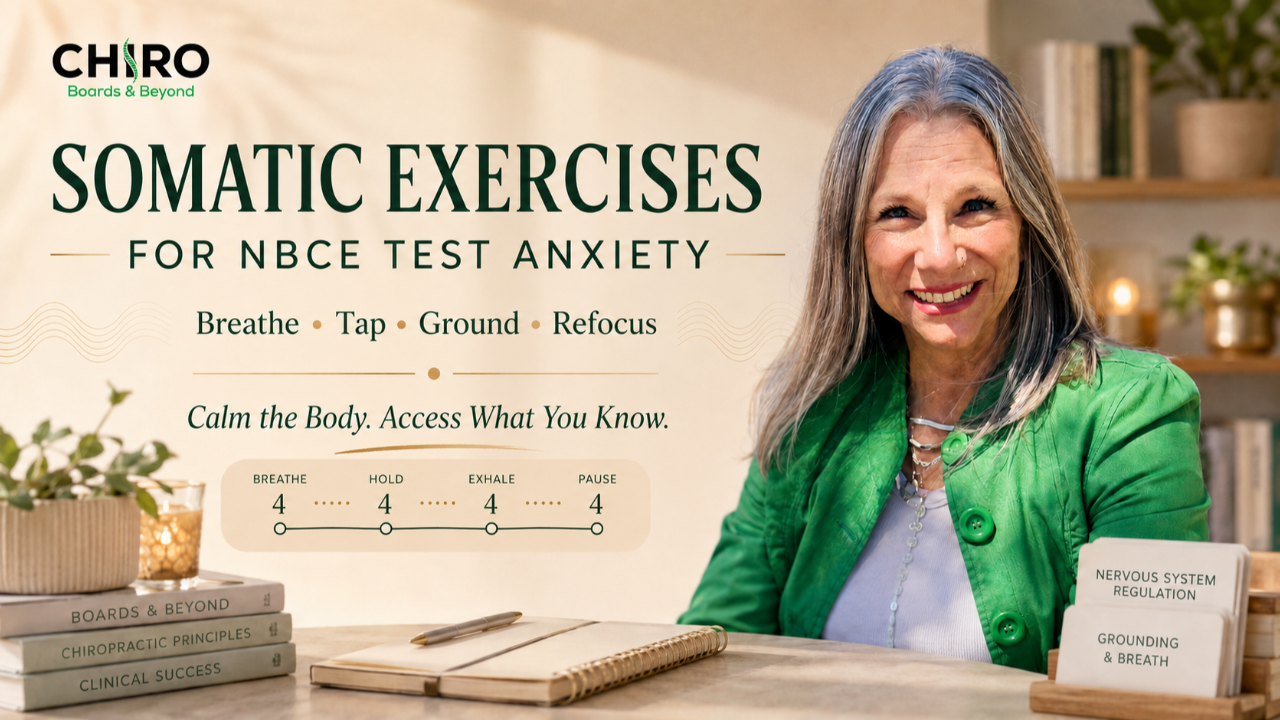
Test anxiety is real, especially for chiropractic students preparing for NBCE board exams. Even when you know the material, your nervous system can shift into fight-or-flight, making it harder to recall what you studied. Racing thoughts, a pounding heart, sweaty palms, shallow breathing, or a sense of dread can interfere with focus and clinical reasoning. Somatic exercises can help you regulate your body first, so your brain has a better chance of accessing the information you already know.
The good news is that you can retrain your nervous system to respond differently. By practicing somatic exercises, you engage both your body and your mind, giving yourself tools to regulate stress in the moment. Let’s explore a few simple yet powerful techniques you can use before and during exams.
Why the Body Holds Stress During Tests
When you sit down for an exam, your brain may perceive the situation as a threat. This activates the fight-or-flight response, flooding your body with adrenaline and cortisol. While these chemicals are useful for escaping danger, they aren’t great for remembering exam material.
Somatic practices help signal safety back to the nervous system. By calming the body first, you create space for the brain to think clearly and access stored knowledge.
For chiropractic students preparing for NBCE exams, test anxiety can be especially frustrating because the exams require more than memorization. You may need to recall anatomy, physiology, pathology, diagnosis, orthopedic testing, neurology, radiology, case management, or clinical decision-making under pressure. When your body feels unsafe, it becomes harder to access that information clearly. Somatic exercises help reduce the body’s alarm response so your studying and clinical reasoning have a better chance to come forward.
Butterfly Tapping for Test Anxiety
The butterfly hug or butterfly tapping is a grounding technique often used in EMDR therapy. It works by crossing the arms over the chest and alternately tapping each side in a slow, rhythmic way.
How to do it:
- Sit comfortably with both feet on the floor.
- Cross your arms over your chest so your fingertips rest just below your collarbones.
- Begin gently tapping one side, then the other, in a slow and even rhythm.
- Breathe steadily while noticing the calming sensation of the alternating taps.
- Continue for 1–2 minutes, or until you feel more grounded.
When to use it:
Use butterfly tapping before studying, before entering the testing room, during a study break, or any time you notice your anxiety starting to rise.
This bilateral stimulation helps quiet racing thoughts and regulate emotions, making it especially helpful just before you open your exam booklet.
Breathwork for Calm and Focus During Exams
Your breath is one of the fastest ways to influence your nervous system. When anxiety spikes, breathing often becomes shallow and rapid, signaling the body to stay in “threat mode.” By consciously slowing your breath, you flip the switch toward calm and focus.
Breathwork for Calm and Focus During Exams
Your breath is one of the fastest ways to communicate safety to your nervous system. When anxiety spikes, breathing often becomes shallow and rapid. Slowing the breath can help shift the body out of threat mode and back toward focus.
Box breathing:
- Inhale for 4 counts.
- Hold for 4 counts.
- Exhale for 4 counts.
- Hold for 4 counts.
- Repeat for 3–5 rounds.
Extended exhale breathing:
- Inhale through your nose for 4 counts.
- Exhale slowly through your mouth for 6–8 counts.
- Repeat for 1–3 minutes.
Extended exhale breathing is especially helpful when you feel keyed up, rushed, or panicked because the longer exhale supports the body’s relaxation response.
Grounding Movements to Release Nervous Energy
Even small movements can release pent-up nervous energy and help you refocus:
• Roll your shoulders forward and back three times.
• Press your feet firmly into the ground and notice the support beneath you.
• Stretch your arms overhead and take one deep breath, then relax. These micro-movements keep your body engaged without disrupting your focus.
A Simple Pre-Test Somatic Ritual for NBCE Board Prep
Test anxiety often comes from feeling out of control. Building a simple pre-test ritual that includes somatic practices can give your body a sense of safety and predictability. For example:
1. Sit down and do 1 minute of butterfly tapping.
2. Follow with 3 cycles of box breathing.
3. Take a moment to stretch and ground yourself.
4. Begin the exam feeling centered and confident.
Frequently Asked Questions About Somatic Exercises for Test Anxiety
What are somatic exercises for test anxiety?
Somatic exercises are body-based tools that help calm the nervous system. For test anxiety, they may include breathwork, grounding, gentle movement, or butterfly tapping to help the body feel safer before or during an exam.
Can somatic exercises help chiropractic students during NBCE board prep?
Yes. Somatic exercises can help chiropractic students reduce physical stress responses that interfere with memory, focus, and clinical reasoning during board prep and exam situations.
What is the fastest somatic exercise for test anxiety?
Extended exhale breathing is one of the fastest tools to use. Try inhaling for 4 counts and exhaling for 6–8 counts for one to three minutes.
What is butterfly tapping?
Butterfly tapping is a grounding technique where you cross your arms over your chest and gently tap each side in an alternating rhythm. It is often associated with EMDR-informed regulation strategies.
When should I practice somatic exercises before an exam?
Practice them daily while studying, not just on test day. Your nervous system responds better to familiar tools, so repetition helps the body learn that these techniques mean safety and focus.
What should I do if test anxiety still affects my board prep?
If test anxiety continues to interfere with studying or exam performance, consider combining somatic tools with structured board review, tutoring, counseling, or other professional support.
Ready to feel more prepared for boards?
Somatic exercises can help calm your nervous system, but structure matters too. Chiro Boards & Beyond helps chiropractic students prepare for NBCE exams with board review courses, clinical reasoning support, and tutoring designed to make studying feel more manageable.
Final Thoughts
Reducing test anxiety isn’t about “toughing it out.” It’s about giving your nervous system the support it needs to work with you, not against you. By practicing butterfly tapping, breathwork, and grounding movements, you create a toolkit for calmer, more focused test-taking.
The more you practice, the easier it becomes to shift from anxiety into calm presence. Remember—your body is your ally, not your enemy, and with the right techniques, you can meet exams with confidence and clarity.
About the Author
Dr. I Jo Kaleta, DC, CCSP, helps chiropractic students prepare for NBCE board exams through clinical reasoning, structured study strategies, and neurodivergent-friendly learning support. Through Chiro Boards & Beyond, Dr. Kaleta supports students preparing for Part I, Part II, Part III, Part IV, Physiotherapy, CCSP, and SPEC board reviews.