Neurodivergent Study Tips for NBCE Chiropractic Board Exams
May 04, 2026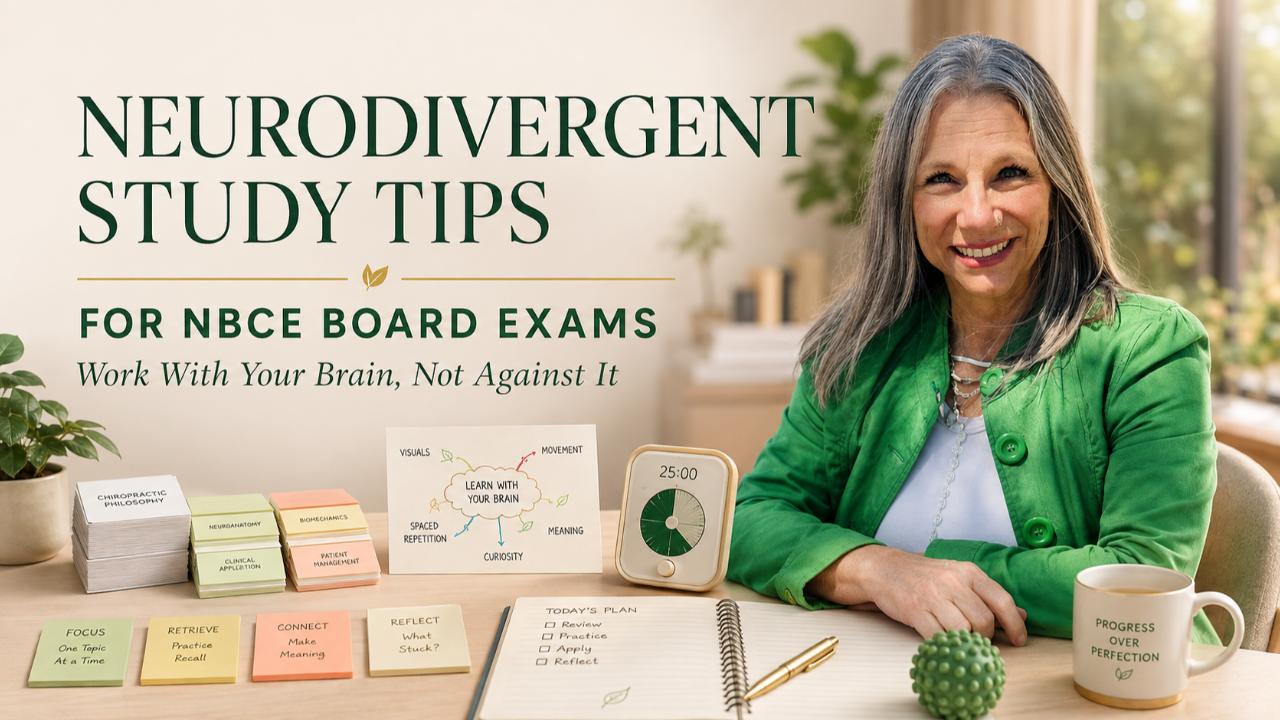
If your brain doesn’t fit neatly into the “sit still, read quietly, and memorize” box, you’re not alone. Many students—especially those who are ADHD, autistic, dyslexic, or otherwise neurodivergent—need a different approach to studying. The good news? Your unique brain is an asset, and with the right tools, you can study in ways that honor how your mind and body work best.
Here are some “neuro-spicy” study tips to help you stay focused, retain information, and keep your nervous system regulated along the way.
1. Chunking to Study for NBCE Chiropractic Board Exams
Long study marathons may sound productive, but your brain prefers short bursts of focus. Break your material into smaller “chunks” and set a timer for 25–40 minutes. After each chunk, reward yourself with a movement break, music, or a quick snack. Small wins add up fast.
2. Move While You Learn
Sitting still can actually shut down your focus if your nervous system craves movement. Try:
• Walking while reviewing flashcards
• Using a standing desk or stability ball
• Doing light stretches between chapters Movement isn’t a distraction—it’s a tool to keep your brain engaged.
3. Make It Multi-Sensory
Reading alone doesn’t always cut it. Mix in different sensory inputs:
• Speak notes out loud to “teach” the material
• Draw mind maps or doodles to anchor concepts
• Use colorful pens or sticky notes to code key topics
• Record yourself explaining a topic, then listen back later The more senses involved, the more memory pathways you create.
4. Play with Your Environment
Your study space matters. Some neuro-spicy brains focus better with background noise, others with silence. Experiment with:
• Lo-fi music, white noise, or nature sounds
• Fidget tools or weighted blankets for grounding
• Changing locations (coffee shop, library, or even outside) Your ideal environment might not look “traditional”—and that’s okay.
5. Hack Your Nervous System with Somatic Tools
When stress spikes, your brain can’t absorb new info. Quick regulation tricks include:
• Butterfly tapping: Cross your arms over your chest and alternate gentle taps while breathing deeply.
• Box breathing: Inhale for 4, hold for 4, exhale for 4, hold for 4.
• Grounding through senses: Notice 5 things you see, 4 things you feel, 3 things you hear, 2 things you smell, 1 thing you taste. These tricks help reset your nervous system so your focus comes back online.
6. Make It Social (If That Works for You)
Some neurodivergent learners thrive with accountability. Try study groups, body doubling (working alongside someone, even virtually), or explaining a topic to a peer. Turning studying into a shared experience can make it less overwhelming—and more fun.
7. Celebrate Progress, Not Perfection
Perfectionism can lead to procrastination. Instead of stressing over how much you should do, acknowledge every chunk you finish. Each step forward counts. Remember: your brain isn’t broken—it just learns differently, and differently can be powerful.
FAQ for: Neurodivergent Study Tips for NBCE Chiropractic Board Exams
1. What does neurodivergent mean in board exam prep?
Neurodivergent refers to brains that process, organize, focus, remember, or regulate information differently. This can include ADHD, autism, dyslexia, anxiety-related executive dysfunction, sensory processing differences, or other learning differences.
For NBCE board prep, this means traditional advice like “just sit down and study for eight hours” may not work well. Neurodivergent students often need more structure, shorter study blocks, visual organization, movement, repetition, and clinically connected learning.
2. Can neurodivergent students pass NBCE board exams?
Yes. Neurodivergent students absolutely can pass NBCE exams. The key is using a study system that matches how your brain learns instead of forcing yourself into a method that creates burnout, avoidance, or shame.
Many students struggle not because they are incapable, but because they are using passive study methods like rereading notes, highlighting, or cramming without enough recall practice and clinical application.
3. What is the best way for ADHD students to study for chiropractic boards?
ADHD students often do better with short, structured, active study sessions.
A strong approach is:
- Pick one small topic.
- Study it for 25–40 minutes.
- Do practice questions immediately.
- Explain the concept out loud.
- Take a movement break.
- Return later for spaced repetition.
This works better than trying to force long, unfocused study marathons.
4. Why do I keep forgetting what I study for NBCE?
Forgetting usually happens when information is not being reviewed actively or connected clinically. If you only reread notes, your brain may recognize the material but not retrieve it under exam pressure.
To improve retention, use active recall, spaced repetition, visual maps, clinical examples, and question-based review. Ask yourself:
“How would this present in a patient?”
“What would I see on exam?”
“What answer choice would NBCE try to trick me with?”
5. Are practice questions enough for neurodivergent board prep?
Practice questions are important, but they are not enough by themselves. Neurodivergent students often need to understand why an answer is correct and how to recognize the pattern again.
After every practice question, review:
- What the question was really asking
- Why the right answer is right
- Why the wrong answers are wrong
- What clinical clue pointed you in the correct direction
That turns practice questions into actual learning instead of just score-checking.
6. How long should neurodivergent students study each day for NBCE?
The best amount depends on your exam timeline, energy, and current knowledge base. Many neurodivergent students do better with multiple shorter study sessions instead of one long block.
For example:
- 30–45 minutes of focused study
- 5–10 minute break
- 30–45 minutes of practice questions
- Longer reset break
- Repeat later if capacity allows
Quality matters more than raw hours. A focused two-hour session can be more effective than eight hours of distracted rereading.
7. What should I do when I feel overwhelmed by board prep?
When you feel overwhelmed, reduce the size of the task. Do not tell yourself to “study boards.” That is too broad.
Instead, choose one tiny next step:
“Review cervical orthopedic tests for 20 minutes.”
“Do 10 neuro questions.”
“Make one chart comparing two conditions.”
“Watch one lecture segment and summarize it.”
Overwhelm usually decreases when the task becomes specific, time-limited, and achievable.
8. How can I study if I have test anxiety?
If test anxiety is part of your board prep, you need both content strategy and nervous system strategy.
Before studying or testing, try:
- Slow exhale breathing
- Grounding through your feet
- Gentle movement
- Orienting to the room
- A short body scan
- Practicing questions in timed but low-pressure settings
The goal is to teach your brain that testing is not a threat. The calmer your nervous system is, the easier it is to retrieve what you know.
9. Is it better to study by subject or by clinical presentation?
For NBCE exams, you need both, but clinical presentation is often more useful once you have the basics.
Instead of only studying “rheumatoid arthritis,” ask:
“How does this patient present?”
“What are the key exam findings?”
“What labs or imaging might matter?”
“How would I distinguish this from osteoarthritis or another inflammatory condition?”
NBCE questions often test your ability to recognize patterns, not just memorize isolated facts.
10. What is the biggest mistake neurodivergent students make when studying for boards?
The biggest mistake is trying to study like everyone else while ignoring how your brain actually works.
Common patterns include:
- Waiting until panic creates motivation
- Rereading instead of actively recalling
- Studying too broadly
- Avoiding practice questions because they feel uncomfortable
- Not building in breaks
- Feeling shame instead of adjusting the system
A better strategy is to create a repeatable structure that gives your brain clarity, novelty, movement, and clinical context.
Final Thoughts
Studying as a neuro-spicy student isn’t about forcing yourself into methods that don’t work for you. It’s about experimenting, finding strategies that regulate your nervous system, and leaning into your natural strengths. The more you tailor your study habits to fit your brain, the more confident and successful you’ll feel.
So grab your flashcards, your favorite fidget tool, and maybe even a yoga mat—and let’s make studying work with your brain, not against it.
Need a board prep system that works with your brain instead of against it?
If you are preparing for NBCE Part I, Part II, Part III, Part IV, or Physiotherapy, Chiro Boards & Beyond helps you organize the material, study with repetition, and build clinical reasoning without shame-based overwhelm.
Start with the free study resources, explore the NBCE board review courses, or schedule a 1:1 tutoring session if you need personalized support.