7 Outside Activities That Help Chiropractic Students Learn Faster
Mar 04, 2026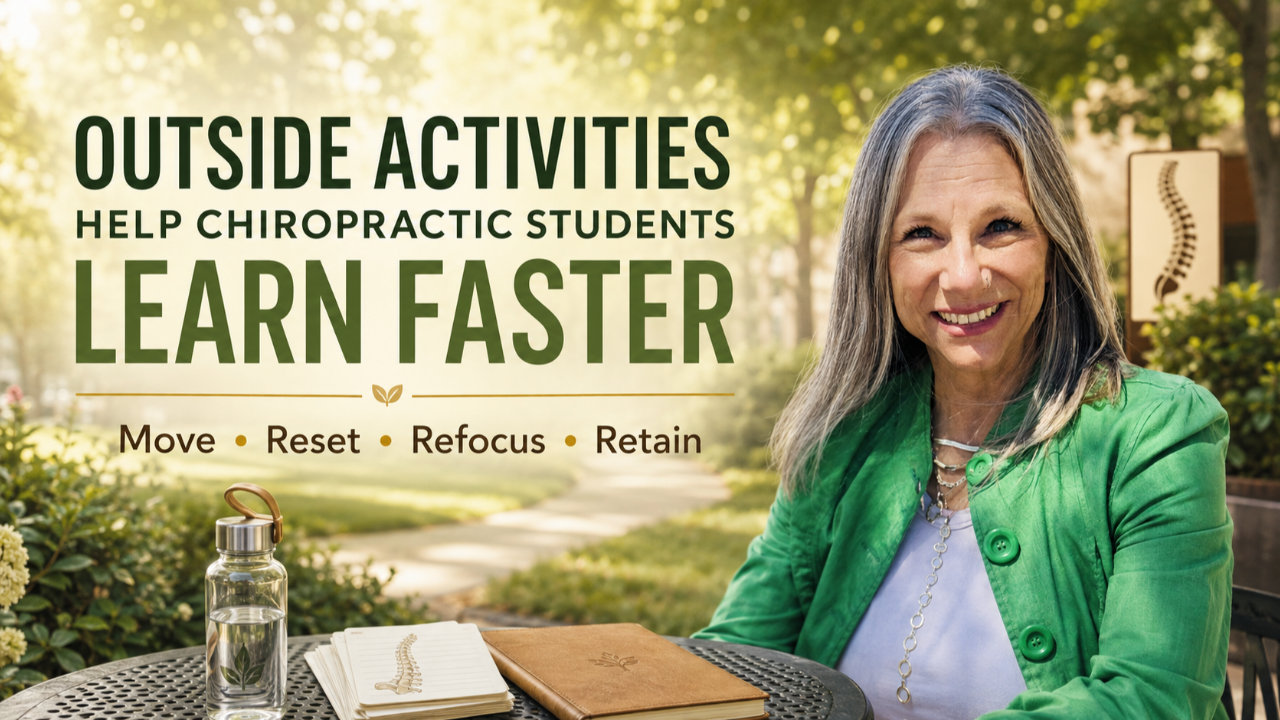
Outside Activities That Make You a Faster Learner (For Chiro Students)
If you are a chiropractic student trying to learn faster, retain more information, and prepare for boards without burning out, the answer is not always to put in more hours at your desk. The activities you do outside of class can improve memory, focus, nervous system regulation, and clinical reasoning. In this article, we will look at outside activities that help chiropractic students become faster, more efficient learners.
1) Move your body like you’re training your brain (because you are)
Regular physical exercise is linked with improved attention, concentration, and memory. Choose something you can do consistently.
- Do 20–30 minutes of brisk walking, cycling, swimming, or lifting before a study block.
- Pick an activity you can repeat 3–5 days/week.
- Bonus: coordination-heavy activities (dance, martial arts, climbing) add extra brain challenge.
2) Learn something “non-chiro” that’s new and complex
A new skill keeps your brain adaptable and strengthens your ability to learn inside school.
- Choose challenge + complexity: instrument, language, art, dance, or any skill you aren’t already good at.
- Aim for 20–45 minutes, 1–2 times/week.
3) Use spaced repetition—anchored to real life
Spaced repetition works best when it’s consistent and attached to routines you already do.
- Review a small set of concepts after workouts or with morning coffee.
- Keep it short: 5–10 minutes beats an occasional 60-minute cram.
4) Teach something small—out loud—every day
Teaching forces your brain to organize information into a usable structure.
- Pick one topic and explain it in 60–120 seconds (to a friend, your phone, or your notes).
- If you can’t explain it simply, that’s your next study target.
5) Switch from passive notes to active note-taking
Active note-taking improves comprehension and retention—especially for systems and clinical reasoning.
- Use Cornell notes, concept maps, or one-sentence summaries per key point.
- Handwriting complex pathways (neuro, imaging patterns, ddx trees) can improve processing.
6) Build feedback loops (instead of just ‘more studying’)
Feedback helps you identify what you avoided or misunderstood—fast.
- Record yourself explaining a concept; rewatch and refine.
- Study with a peer and ask: ‘What was unclear?’
- Weekly self-audit: What did I avoid this week—and why?
7) Start with behavioral + physical strategies first
Cognitive enhancement isn’t one thing. Behavioral and physical changes are usually the highest-ROI and lowest-risk first steps for students.
- Behavioral: active recall, spaced repetition, teaching, feedback loops.
- Physical: movement, consistent sleep routine, stress regulation habits.
What helps chiropractic students learn faster?
Chiropractic students often learn faster when they combine active recall, movement, sleep, nervous system regulation, and hands-on clinical practice.
How can I study for chiropractic boards without burning out?
Use shorter study blocks, movement breaks, active recall, and scheduled recovery time so your brain can consolidate the material.
Does exercise help with studying?
Yes. Exercise can support focus, mood, memory, and stress regulation, all of which can help students study more effectively.
Why do chiropractic students struggle with retention?
Many students struggle because they rely on passive review instead of active recall, clinical application, spaced repetition, and nervous system regulation.
What is the best study method for chiropractic students?
The best method is usually a combination of active recall, spaced repetition, clinical reasoning, and teaching the material out loud.
A simple weekly ‘brain upgrade’ plan
3–5 days/week
- 20–30 minutes exercise before study.
2 days/week
- One new skill practice (instrument/language/art/dance) for 20–45 minutes.
Daily (5–10 minutes)
- Teach one concept out loud.
- Quick spaced repetition review.
Weekly
- One feedback session (peer review, self-audit, or coaching-style check-in).
Final thoughts:
Quick Checklist: Activities That Help Chiro Students Learn Faster
After studying: Take a 10–20 minute walk
Before studying: Do breathing, yoga, or mobility work
During review: Teach the concept out loud
After long study blocks: Go outside or change environments
Weekly: Practice hands-on clinical reasoning
Daily: Prioritize sleep and recovery
Your brain doesn’t learn best when you push harder. It learns best when you prime attention, train consistently, and repeat with strategy.
Need help studying smarter for chiropractic boards? Explore Chiro Boards and Beyond for board review support, clinical reasoning strategies, and tutoring designed for chiropractic students who want to learn more efficiently without burning out.
About the Author
Dr. I Jo Kaleta, DC, CCSP, has over 20 years of experience in chiropractic practice and teaches chiropractic students preparing for board exams. Through Chiro Boards and Beyond, Dr. Kaleta helps students connect clinical reasoning, nervous system regulation, and board preparation strategies so they can study more efficiently and succeed in chiropractic school and beyond.